Sunday, September 7, 2014

Gaming for a Good Cause

Sadly, we live in a world where there is no shortage of people in need. And, in Washington, DC, there is certainly no shortage of non-profit organizations, lobbyists, and independent philanthropists eager to promote their respective causes.  It can be challenging for someone who wants to give back to determine the best way to contribute, or which cause to support.  As for me, I never feel like I have the time or money to give back nearly as much as I want to and I constantly struggle to find the balance between family priorities, personal hobbies, work, and community involvement.

Last year, I came across the Extra Life marathon on social media. "Play Games, Heal Kids," was the headline I saw on their website.  I learned that it is a gaming marathon founded in 2008 in honor of Victoria Enmon, a teenage gamer that lost her life to leukemia.  Extra Life encourages participants to raise money for their local Children's Miracle Network (CMN) Hospital.  It works much like a walk-a-thon in that the 24-hour gaming period is completed on the honors system and can be any form of gaming: console, PC, tabletop, etc.  All the money raised by Extra Life participants goes to the CMN hospital of the participant's choice to save kids' lives. Last year, Extra Life raised an amazing $4.1 million! I signed up, raised a humble amount, and spent my gaming hours playing Defiance online.  By being involved in Extra Life, I even received some codes for upgrades and special gear for for the game.  It was awesome to have some fun gaming and also know that I had contributed to a great cause.  

As an avid gamer, I thought Extra Life was a great idea: a way to get gamers proactively involved to give back to children who need live-saving medical care.  On a personal level, it was a great way to balance my passion for gaming with supporting the community in a really meaningful way.  Since the birth of my little girl this past spring, the fundraising behind Extra Life has taken on even greater meaning for me as a parent.  Additionally, one of my neighbors had a son this year who was born with a very rare heart condition and recently received a heart transplant at Children's National Medical Center here in DC.  I'd like to think that the money raised through Extra Life, in some small part, has allowed him to get the long-term treatment he needs.  

The Extra Life DC Guild was founded this year to support an ever-growing number of gamers around DC who realize the impact that the gaming community can have through this gaming marathon for children all over the country.  The Guild has participated in many recent conventions and gaming events around DC to recruit new members and increase awareness about this great cause.  Keep an eye out for us at upcoming local events, including Magfest 8.5, the Red Bull Battlegrounds, and Anime USA. (check out a complete calendar of upcoming events at my website.)

It is great to see that Extra Life and other gamer-oriented charities are showcasing how gamers are doing good things--combating the stereotype of the lazy, couch-potato gamer in his or her "bubble," disconnected from the world.  I would be remiss if I did not recognize the many initiatives out there besides Extra Life that demonstrate the gaming community is giving back in different ways:  Gaming for Good, which sells games online with the proceeds going to Save the Children; Child's Play, which provides video games and consoles to children's hospitals; and Special Effect, which leverages new technologies to allow handicapped individuals to play video games, just to name a few.  If you work with another great gamer-oriented charity, please comment below to give them a shout-out.

The bottom line is this: if you're a gamer and aren't currently involved in charitable gaming, think about joining the community.  Find your cause, step up and give it a shot.  You might be surprised at how much satisfaction you get from giving back a little!  If you think Extra Life might be a good start for you, please give it a try and sign up for free at www.extra-life.org.


Monday, August 25, 2014

Game Review: Valiant Hearts Revisits the Great War, 100 Years Later


July 27th, 2014 marked the 100th anniversary of World War I.  Therefore it seemed appropriate to play the recently released Valiant Hearts which, in its own way, pays tribute to the "unsung heroes" of The Great War.  I have always been interested in games with a true historical basis, so I've had this game on my to-play list for a while.  Valiant Hearts is a unique side-scrolling, puzzle-adventure game by Ubisoft featuring detailed and accurate historical context, diverse puzzles, compelling characters and an emotional storyline which collectively make for a memorable game experience.

Valiant Hearts' story begins in Saint-Mihiel, France, and introduces two of the four characters that the player will control throughout the game: Emile, a widowed farm owner in Saint-Mihiel who is called up to serve in the French Army shortly after war was declared; and Karl, a young German living and working at Emile's farm, who is married to Emile's daughter and was forced to leave France after war was declared. Later in the story, two more playable characters are introduced, an American fighter and a Belgian munitions factory worker.  I would be remiss if I didn't mention a fifth playable character: Walt, a Doberman Pincher K9 medic, who helps out the other characters throughout the game and is critical to their success--not to mention, ridiculously cute.  (Spoiler Alert: No, the dog doesn't die at the end....if he did, I probably would have thrown my controller at the screen).


The player starts the game controlling Emile as he is going through basic training with the French Army--which also serves as the basic training for the player to learn the controls for the game.  Valiant Hearts uses extremely simple controls for interacting with the environment; for example, using the square button to execute each character's special skill, like digging or cutting wires.  In addition, many actionable items have a "button prompt" hovering over them so that you know you can interact with them.  In addition, the inventory of the character is streamlined to only what the character is carrying on his or her belt, plus whatever Walt the dog might have.  This simplicity further emphasizes the game's focus on storytelling and character development, rather than a flood of attack combos and a giant inventory of supplies and weapons, which is often the case in other war-themed games.   

One of the many puzzles throughout the game. (Photo
courtesy of Ubisoft Entertainment)
As the game and story progress in chapter style with a narrator, the player will rotate through gameplay with each of the four "unsung heroes."  They will encounter a series of diverse puzzles to solve on the battlefield, in a prison camp, or on the city streets, with varying difficulty.  Some tasks may require the use of various items in cooperation with Walt the Dog, distracting enemy soldiers, digging around mines, or moving objects in the correct sequence.  

There are some legitimate battle sequences that give a sense of the stress on the battlefield, as the character dodges airborne attacks, hides in bunkers, and narrowly escapes enemy fire or chemical attack. I found the time-pressure puzzles for Anna (the Belgian munitions factory worker) to be particularly stressful, as she is often charged with healing people wounded in battle.  The player controls Anna's administration of first aid through a series of rapid button-pushing sequences, which must be executed at precisely the right time and in the right order to save the patient.  Every time the player misses a button, you can see the patient bleeding more!  
Anna uses her medical skills to help a war victim.
(Photo courtesy of Ubisoft Entertainment)


Despite the artificial stress created by certain puzzles and time-limited actions, Valiant Hearts is generally forgiving with respect to saved games and resuming play if a character dies.  There are auto-save checkpoints at the start of each chapter and no penalties for having to play through a particular chapter many times to advance.  I personally found this generosity, as well as the simplicity of the controls, to be almost too simple to provide satisfying and challenging gameplay.  But again, I think this goes back to the idea that the developers really wanted players to focus on the story.

Another unique aspect of this game is the inclusion of extensive historical data about the World War I.  Facts are interjected via sets of hidden collectibles and historical items in each chapter.  When the player collects an item, a new fact card is added to the player's deck.  I found it really interesting to read through them and learn more about what happened during World War I.  The fact cards are short enough to where I didn't feel like I was reading a history book, and they usually bore some relevance to the game's story line or puzzles at the end. 

The graphic style of Valiant Hearts has the feel of an interactive
cartoon. (Photo courtesy of Ubisoft Entertainment)
Stylistically, Valiant Hearts is also unique in its comic book graphic style.  The game was rendered using Ubisoft Montpellier Studio's UbiArt Framework.  The artistic idea was to make the player feel like they are interacting with a cartoon, and the game environment effectively conveys that feeling.  However, I have to say I felt slightly uneasy about the scenes in the game depicting mounds and mounds of bodies (when depicting the Battle of the Somme, one of the bloodiest battles of the War) in the game's friendly-looking cartoon style.  It had a big emotional impact.  The game's soundtrack was fairly memorable and complemented the game well.

I don't want to spoil the story, but let it suffice to say that Valiant Hearts does an excellent job intertwining the stories of the four "unsung heroes" illustrate how the transition to modern, total war of World War I affected individuals from a variety of angles, not just the perspective of the soldier.  The perspectives of the characters transcend generations and still resonate with me in relation to current world events.  I appreciated the historical context of the game and the developer's efforts to ensure the accuracy of the facts included (even receiving certification from the French Commission on World War I).  

If there is one thing I cannot reconcile about Valiant Hearts, it is the intended audience of the game. Who is it? As a thirty-something American female gamer, I can appreciate the historical education aspect of the game and the focus on story rather than complexity of gameplay.  I am not sure that many younger American gamers would enjoy Valiant Hearts solely for the story or actually read the historical facts, but perhaps European gamers would be more attuned to this aspect of the game.  I am also doubtful the gameplay would appeal to gamers who gravitate toward first-person shooters and heavy action games.  Valiant Hearts is truly unique, which is both a blessing and a curse in terms of its appeal to large audiences.  The game's strength lies in its compelling story and its focus on the interpersonal relationships of a diverse set of characters to illustrate the effects of war.  If that sounds appealing to you, I highly recommend you check it out.   


Wednesday, May 28, 2014

Blog and Website Hiatus: Make Way for Capital Gamer Baby...


Hey there everyone.  You may have been wondering about this extraordinarily long hiatus I've taken from the Capital Gamer blog and website.  Well, in case you missed it on the other social networking outlets, this gamer girl has been incubating a human being for the last 8.5 months.  I have learned so much about pregnancy that no one ever talks about....like who knew morning sickness is actually all-day sickness?  And that even though I was sort of joking when I referred to my unborn child as a parasite, it is actually a somewhat accurate description?  Nausea, swelling, food aversions, difficulty breathing, and, in my case, bed rest...ah, I could go on, but the bottom line is that all these wonderful things have definitely impacted my gaming and cosplay pursuits.


But do not fear!! 2014 is a rebuilding year for Capital Gamer. And when I'm back up and running--hopefully this fall--you can bet there will be even more projects, reviews and cosplays, with the added bonus of incorporating our new bundle of joy into our cosplay plans for 2015.  A whole new world of opportunities!!  So please stay tuned for future updates on here, and also via my Twitter account @CapitalGamerDC.  In the meantime, thanks for your support!  

Thursday, October 17, 2013

Review: XCOM: Enemy Unknown

Why can't we work things out? Little people, why can't we all just get along?
-- President Dale, Mars Attacks
 
 
Okay, okay. I know I'm way overdue writing a review for XCOM: Enemy Unknown.  But give me a break!  There's been too many great games to play and not enough time.  That, and throw New York Comic Con into the mix and, well...enough said.  Anyway, enough excuses.
 
XCOM: Enemy Unknown is a turn-based, action-strategy game that makes you the commander of XCOM, an elite paramilitary organization charged with defeating an unknown alien threat.  In order to accomplish this daunting task, you must organize your XCOM base, manage strategic assets across the globe, train soldiers, execute missions, develop alien technologies, and numerous other activities that come with the territory--you know, saving the world and all that.
 
After a long period of playing primarily first-person shooters and point-and-click adventures, I found XCOM's strategic and turn-based action components to be a refreshing change.  At the XCOM base (in between missions), there are a wide range of things to do: recruiting new soldiers; researching different technology to improve armor, weapons, and aircraft; building new facilities to expand your base; and managing satellites and country relations throughout the world to combat the alien threat.  When you get tired of doing activities around the base, you can deploy your team to Earth to complete missions involving civilian rescue or alien threat "neutralization."  The balance between strategy and action, coupled with an underlying sense of urgency and easy flow of gameplay, makes XCOM quite addictive.

Soldier customization screen prior to starting a mission.
Photo courtesy of gamereuphoria.com
The most fun part of the game was controlling the XCOM team on the ground during missions, allowing you to use unit-level tactics to defeat the aliens and save civilians.  The turn-based action takes your soldiers through alien-ravaged city streets, warehouse districts and alien spacecraft to achieve the mission.  Your team includes five soldiers which start out as Rookies but can achieve up to the rank of Colonel once they gain enough mission experience and kills in battle.  Each soldier receives a specialty designation: assault, sniper, support, heavy, and eventually psionic (a special alien-derived skill set).  You can also customize each solider--not just their gear, but their names and appearance as well--and rotate out soldiers to ensure the best combination of skills for a particular mission.  But unlike some other games, a soldier's death in XCOM is permanent, which can have a significant impact on your team and mission outcome, depending on that soldier's rank and skill set.  You can always recruit more, but a high-ranking soldier takes time to develop. 
 
Example of a mission mode scene during battle.
Photo courtesy of gamedynamo.com
While the turn-based action was my favorite part of XCOM, it is also the part with the most deficiencies.  The scenery and mission layouts could get repetitive, particularly later in the game, but in general the gameplay was engaging enough to distract from the deja-vu effect.  What wasn't easy to ignore were the recurring issues with navigating soldiers through multi-level buildings and executing attacks.  While I applaud Firaxis Games' efforts at developing what must be a fairly complex combination of maps and player actions to make the gameplay as smooth as possible, there were undeniable issues with transitions between levels of buildings and changing viewing perspectives to evaluate enemy locations and attack options.  In addition, there were numerous glitches where enemies and even soldiers' gear randomly disappeared in the middle of missions, and then randomly reappeared (not as part of the alien powers!), which is just annoying.  And lastly: hit percentages.  Every soldier has a percent change of hitting their intended target prior to shooting, which is displayed at the bottom of the screen.  This is to allow the player to make a determination if shooting from that location is effective.  There were way too many times that the hit percentage was listed as 80-90% and my soldiers would miss their intended target.  Way more than even random chance would account for.  I can do math, and this math didn't make sense.
 
 
Situation Room screen.
Photo courtesy of giantbomb.com
Back at the XCOM base, most of the gameplay is straight forward: toggling between your lab, engineering, command and control, and your barracks to manage various aspects of your alien-fighting operation.  The only issue I had with this part of the game was that I had to rely on retrieval of supplies and artifacts from missions in order to be able to build new things.  There's an option in the Situation Room, called the Gray Market, where your team can sell artifacts and supplies that are no longer needed.  If we are able to sell items to other countries, why can't we buy them as well?  A lack of certain resources often precluded me from building certain new technologies, thereby delaying the overall forward movement of game.  I am sure that this limitation is intended to auto-regulate the game tempo, but I would have preferred to have the flexibility to procure some items through the Gray Market and accelerate the readiness of my team for the more challenging missions later in the game.
 
Overall, the balance between turn-based action and global strategy makes XCOM appealing and addictive.  However, I can't give it a resounding two thumbs' up because of the drawbacks in the mission mode that ultimately made me impatient and annoyed toward the end of the game.  But I still had to finish it to save the world and avoid alien domination.  I'll be interested to see what the future of the XCOM franchise holds.
 

Wednesday, September 11, 2013

Borderlands on a Budget: Part 2 of the Budget Cosplay Series


Full-length view of Handsome Jack
My blog post from this past April, Bioshock on a Budget, focused on assembling a cosplay for under $50.  The article was so well-received that I recently decided to do a follow-on project.  This time I chose Handsome Jack, a character from one of my other favorite games, Borderlands. I thought this cosplay would be a great fit for my husband to accompany my Mad Moxxi cosplay, in anticipation of Baltimore Comic Con last weekend.  And, looking at the elements of Handsome Jack's outfit, I thought it would be realistic for me to put together the cosplay for under $50.  Was I successful?  Read on to find out!


This close-up screen shot of Handsome Jack shows the facial
detail and several of the accessories I would need to
construct to make an accurate cosplay.
For those unfamiliar with the character Handsome Jack from Borderlands, he's the bad guy.  In fact, he's the biggest jerk in all of Pandora.  That being said, his look is pretty awesome and distinctive enough to make a great cosplay.  It also has a lot of elements that I thought I could realistically find at the thrift store and modify for the cosplay--much like my Elizabeth and Booker cosplays from Bioshock Infinite.  The main structural elements of Handsome Jack's outfit are a gray blazer, white collared shirt, orange crew-neck shirt, and dark pants with sneakers.  But you can see from the photos that there's a lot of small accessories, including the digital "mask" pieces on his artificial face.  So really, the devil is in the details on this one, and I spent a majority of my time working on those details to make a convincing cosplay. 
 
Knowing that the accessories would be the biggest time sink, I started with those. Most supplies I needed came from the local crafts store (Michael's) and items were primarily constructed of foam board or balsa wood. Both materials are fairly easy to work with (scissors for foam, exacto knife for balsa wood) so you don't need a ton a crafty skills to do this.

This is the wood facing  glued on the face of a 
standard silver belt buckle. The wood was later
painted silver.

The start of the belt buckle, a
2x3 flat wood piece with details made from
fancy construction paper and some
fabric-coated wire.
First I made the belt buckle and Jack's aqua-colored light array on his lapel.  I used a 2x3" flat wood piece from Michaels (sold as a set of 5 for $1.99) and glued it onto a standard silver belt buckle.  for the front details, I cut a small circle out of some sparkly aqua-colored paper and glued it to the wood.  I used a small piece of fabric-covered wire around the edge of the paper to give it a more finished look. 
 
For Jack's lapel light array, I used balsa wood.  I traced a hexagonal shape onto the wood, and carved it out using an Exacto knife.  Then I just used some regular sand paper to smooth out the edges.  Later, this wood shape was painted with silver acrylic paint and the circular center was painted with an aqua-colored paint.  I added in the line details with a slightly darker color paint. 

The start of the light array on Handsome
Jack's lapel, carved out of balsa wood with
an Exacto knife. I traced the shape outline
on the wood with pencil before cutting,
then sanded down the edges after cutting.
 
Next, I focused on creating the digital facial attachments, necklace, bracelets, vest buckles.  I went to Amazon and was lucky enough to find inexpensive options for the bracelets (two for $6) which were black, but I painted the exterior with silver paint.  I bought the plastic buckles from Michael's for $2.99, and painted them each a slightly different color using a combination of brown, orange, silver and aqua acrylic paints (each $0.99 at craft store).  


The foam board pieces that would
eventually be used as Jack's digital
facial pieces.  I painted them with
silver paint and added acqua paint
for accents to give it a more digital
look, and used dark grey to add
details that mimicked metal hinges
and screws.

 For the facial attachments to create the basis of Jack's "mask," I cut out foam board pieces, glued them together and painted to resemble small electronic components.  These are lightweight enough to be attached to the cosplayer's face using eyelash adhesive.

Here's what the necklace looked
like once buttons were strung
and painted.
Jack's necklace was a bit tricky as I needed to inexpensively construct something with square, metallic-looking pieces, but could not find any right-shaped beads or jewelry at the craft store. I ended up buying a cheap bag of nean-colored square buttons, and painting them dark gray/silver. I then used some plastic stretch cord to connect the buttons.  It wasn't the sturdiest construction ever, but it got the job done!


Next, I did a few little detail items for Jack's blazer: a patch on the right sleeve (which you can see in the screen shot above) and some other electronic component pieces for the shoulder boards on the blazer.  I just used bright orange paint on a scrap piece of brown fabric from another project, and later sewed the patch on the blazer. For the shoulder boards, I crafted the electronic component pieces the same way I made the previously mentioned facial "mask" pieces...silver and aqua paint on foam board.

Miscellaneous accessory components in varying stages of completion (clockwise
from bottom left): Neon buttons used for necklace; balsa wood aqua light array on lapel;
electronic components for blazer and facial attachments; plastic buckles for vest; arm cuffs;
and decorative arm patch for blazer (center).


Here's the brown leather vest (already
in our wardrobe) with plastic buckles attached to
buttons using clear stretch cord, pictured left.

And finally: the actual clothing. I found a gray suit jacket at the thrift store for $8.99.  As cost-saving measures, I decided to just use jeans for the pants  and a pair of existent brown loafers for the shoes.  We were lucky to have a brown vest already in our wardrobe (see my comments at bottom about work-arounds for this).  I also found an orange tee at the thrift store, and some white sheet fabric to make the shirt tail that extends below Jack's blazer.  Both of those cost a total of $5.50.  I had some leftover gray fabric from another project which I used to make a couple embellishment straps on the blazer, and used some of those leftover orange buttons from the craft store to decorate the straps.  I made the shirt tail as an attachable piece for the back of the blazer.
The finished shirt tail,
made of a white sheet
bought at thrift store.
 
Now I have to admit that since I did my Bioshock on a Budget blog entry in April, I have learned to sew...not well, but good enough to follow some basic patterns and modify pre-made clothing.  So for Jack's white shirt tail, I cut a whale tail shaped piece of fabric, finished the edges with the sewing machine, and pinned the fabric to the blazer.  Sounds pretty easy but it took a lot longer than expected...I was sewing like the wind the night before Baltimore Comic Con!
 
So Friday night I put everything together, and Saturday morning was spent doing the facial makeup for Handsome Jack.  I used eyelash adhesive for the electronic components, and some light-tone liquid makeup outlined by a brown eyeliner pencil to create the illusion of a mask.  I also made the eyebrows more pointed using the eye pencil. And there you have it!


Breaking down all the supplies and costs, let's see how we did:
Foam Board     $1.99
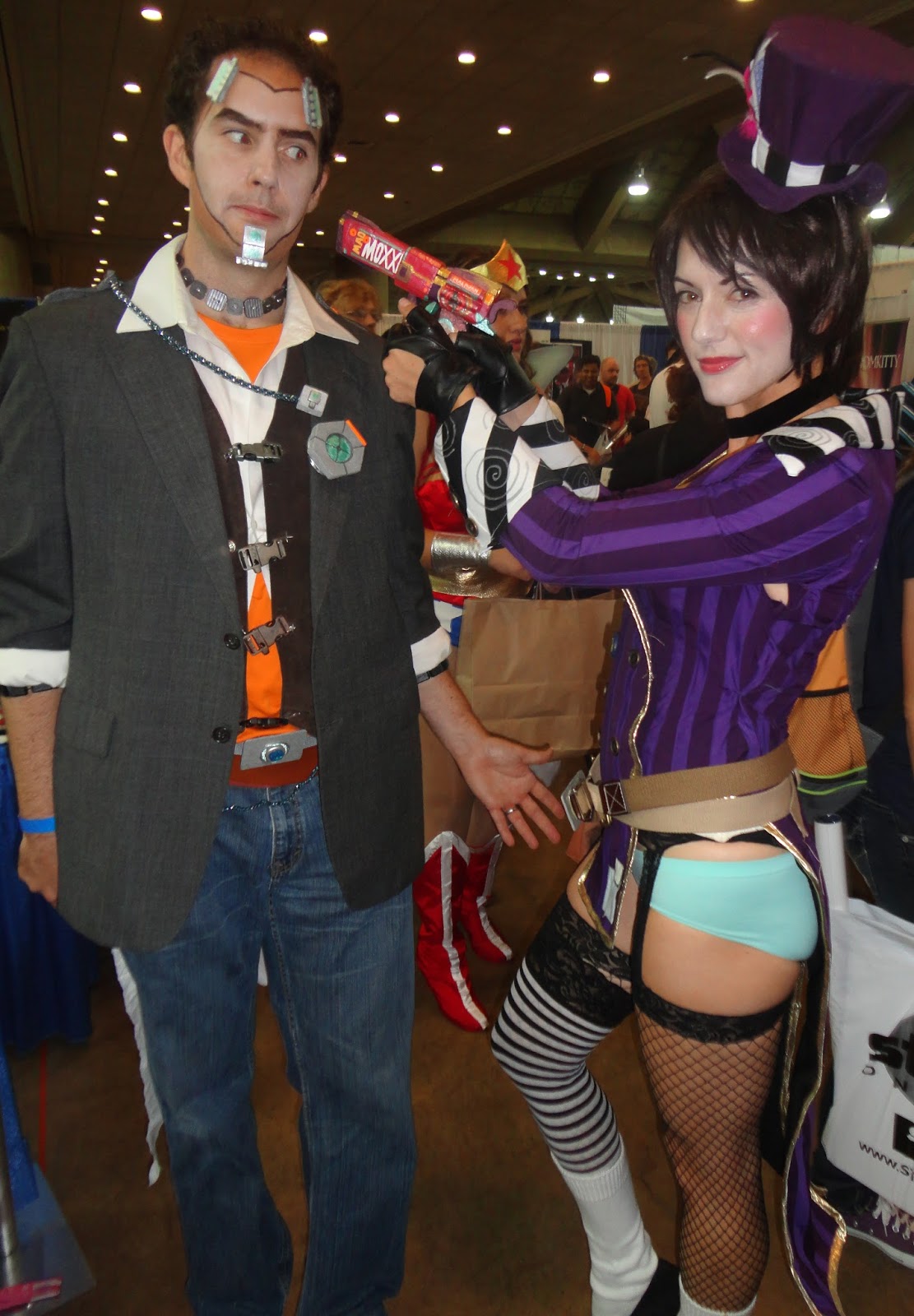
Me as Mad Moxxi and Jon as Handsome
Jack at Baltimore Comic Con 2013.
Balsa Wood     $3.99
2x3" flat wooden pieces $1.99
Aqua-colored art paper $1.99
Clear stretch cord $2.99
Bag of plastic buttons $1.99
Craft glue $2.49
Plastic buckles (6) $2.99
Plastic bracelets $6.00
Metal belt buckle $0.99
Acrylic Paints (4 used in this project) $4.00
Gray suit jacket $8.99
White fabric for shirt tail $2.99
Orange tee shirt $2.50
Leather scrap fabric  $5.99
Exacto knife $5.99
 
TOTAL $57.87
 
So not quite under $50, but pretty close! I must mention that many of the items above were actually purchased for previous craft projects (Exacto knife, craft glue, paints, scrap fabric) and really are multiple use items...so technically I could have omitted them from the shopping list and I would have been under the $50 budget.  But one other caveat is that I did NOT include the brown leather vest in my cost totals, because it was in my husband's wardrobe already and I have no idea how much it cost.  That being said, I priced some similar-looking orange-brown fabric at the fabric store which was $4.99/yd, so you could conceivably make something for under $10.  Alternatively, you could get lucky and find a vest at the thrift store. Even if the color is inaccurate, you could paint the vest or pin some right-colored fabric over the front. This would be the least expensive option but could potentially require a bit more time to find and/or craft.
 
I hope you enjoyed this edition of the Budget Cosplay series!  Feel free to comment below if you have questions or feedback.

Saturday, September 7, 2013

Mobile Game Review: Middle Manager of Justice!

Tired of the same old boring office routine at work? Do you want to punch the clock while also punching evil in the face?  Then Double Fine's Middle Manager of Justice might be a great game choice for you!  This iOS/Android game is a bundle of superhero-packed fun, putting you in the manager position at  Justice Corp--perhaps the only office where wearing spandex to work is mandatory.  You're in charge of overseeing professional development, crime fighting, and the general well-being of a band of superheroes that you have recruited.  So really, the fate of your crime-ridden, alien-infested city and its neighboring communities--or even the WORLD--rests in your hands!

I found Middle Manager of Justice to be extremely addictive and entertaining, with clever dialogue and colorful characters--certainly enough to get me through four long flights over the Labor Day weekend.  Your middle manager is initially afforded the opportunity to recruit one superhero for Justice Corp, which gets you through the tutorial phase of the game.  As your new hero fights crime and wins the favor of the surrounding neighborhoods, your Justice Corp branch begins to earn money and superium, the latter allowing you to recruit additional superheroes.  But sending your heroes out to battle and earning cash isn't enough to get through the game: opponents get progressively harder (go figure), and your middle manager must ensure that the superheroes are, well...managed--that is, they receive additional training, morale-boosting, and rest as needed!  So you must distribute finances to effectively expand your Justice Corps facilities and buy new gear for your heroes so they can keep fighting evil for another day.
Snapshot of the Justice Corp branch office screen, showing the various facility
upgrades that can be purchased throughout the game.
 
There are only a few main screens to navigate in the game.  The first one is your Justice Corp branch office, where you assign tasks to your middle manager and superheroes, upgrade facilities, and purchase new items.  Certain rooms are needed at the Justice Corp office pretty early in the game, such as a gym to train up your heroes and a bedroom to get them rested for the next fight; but other facility upgrades can be bought later, such as a lab to research new equipment, or extra cubicles where heroes can do desk work to increase the office profit when they're not out fighting.  All this activity probably doesn't sound really complex, and it's not... until you start juggling the activities of three or four superheroes.  Suddenly all those multi-tasking skills come in handy!  But don't worry, you won't have to deal with paperwork like most middle managers do.  Phew.
 
The second main screen you will navigate is your city status screen, which allows you to view outstanding crime activity--where your heroes can engage in battle--and the level of satisfaction each district has with your crime-fighting activities.  Districts where you dispense justice quickly will be more satisfied, and therefore yield more money for your branch.  You also get more money for responding to potential engagements as quickly as possible.  Each battle icon displays a clock countdown which determines how much experience and money you will get from succeeding in that battle.
 
This is a yak that you can buy for your
office, which dispenses unlimited warm
yak milk for your heroes during battle.
Yum!
The third and final screen is your battle mode screen.  From here, you will manage your heroes during an engagement, provide them with helpful consumable items as needed, and utilize their special powers as available.  It should be noted that you will have the option to "delegate" battles, which allows you to skip the battle mode screen and go about doing other things while your heroes are fighting.  This should only be used if you are fairly confident that your heroes can manage the battle without assistance (you'll get to see a % chance of success when you select your heroes for a given battle),  but the delegation option can be immensely helpful in saving time when you're trying to simultaneously manage activities of a larger group of heroes.


Sample of the battle mode screen with the Masked
Mummy and Captain Premium dispensing justice.

Overall, the interface works well and allows you to move along quickly.  While there is some funny dialogue that I personally enjoyed reading (one plot section involves a displaced Canadian dragon), it's very easy to click through all of that if you just want to get through the game.  I think a player could complete the main game mission with three heroes, so there's not a ton of incentive to recruit more than that. Having more than three makes the game more challenging because you have more people to manage.  I found the various heroes available for recruitment entertaining and wanted to see the different special powers of characters like Surge Protector, @Man, and the Masked Mummy, so I ended up with a total of six heroes by the end of the game.  My play-through inevitably took longer because I was sharing my resources amongst six people, but it was worth it!

This is Sweet Justice, my first hero
recruit. Isn't he cute in his lil' mask?
 
While the main gameplay screens are fairly easy to navigate, later in the game it was somewhat cumbersome to locate, cycle through, and assign tasks to all six of my heroes from the Justice Corp branch office screen.  You can only have four active heroes at any given time, so you have to continually jump to another screen to toggle on/off characters.  Sometimes the swapping-out changes wouldn't take, necessitating repeat attempts to cycle characters.  This can be frustrating when you are trying to move quickly amongst characters to deal with a battle or get them rested up for the next fight.  I think there is probably a better way to integrate this function with the office screen.
 
Overall the game was very engaging, but the mundane "office" tasks (such as sending heroes to rest or boost morale) just became tedious after a while. But you still have to do those tasks to level-up your heroes enough to beat the next bad-guy boss.  There are premium options available that will allow you to move things along faster--you can use real money to buy more superium, which allows you to expedite training of your heroes, recruit more heroes, etc.--so I imagine the theory is that players will pay that money to get through the game faster.  Still, if you want to play MMOJ as a completely free-play game, it's a tolerable level of monotony given the other positive traits of the game.
 
Middle Manger of Justice is a mobile game well worth your time--approximately 10-12 hours of your time, based on my play-through this past holiday weekend.  It encompasses all the little fun details of artistry, dialogue and quirkiness we have come to love and expect from Double Fine Productions.  So get out there and use your thumbs of justice to fight some evil, middle manager!


Friday, August 16, 2013

Book Review: A Shadow in the Flames, Michael G. Munz

I recently had the opportunity to read A Shadow in the Flames, the first novel by Seattle-based sci-fi/fantasy writer Michael G. Munz.  A near-future science fiction adventure/thriller, the story follows a colorful cast of characters whose personalities and backgrounds are slowly revealed and developed throughout the book.  In the run-down city of Northgate we are introduced to Michael Flynn, a young, hopeful, but unemployed man whose only family is a freelancer named Diomedes.  The plot begins to take shape when the apartment shared by Diomedes and Michael burns to the ground, and the two embark on an adventure to determine the cause of the incident.  Munz also introduces a second set of characters conducting excavations on the moon, whose own discoveries are unveiled in chapters interspersed throughout the book.
 
As Diomedes and his new protégé Michael seek out answers about the fire, additional characters enter the picture: Brian, an overly-inquisitive reporter who is a magnet for trouble; Caitlin, a level-headed member of an underground intelligence-gathering organization; Gideon, a morally-conflicted vigilante; and my personal favorite, Felix, an independent information collector who accompanies Diomedes and Michael throughout much of their adventure, adding a dash of dry humor as needed. 
 
A Shadow in the Flames is written in the third person, with the character focus changing each chapter.  This writing style gives the reader a glimpse of the characters' thoughts, motivations, and backgrounds, but not everything is revealed.  At first I found this a bit aggravating, since most of my recent reads were written in the first-person perspective.  However, after more thought, I realized that Munz's choice for perspective is part of the mystery inherent to the story and is consistent with a central theme in the book: that things (and people) are not always what they seem. 
 
While there is certainly a focus on character development throughout the book, it does not overburden the arc of the story; there are plenty of action sequences and entertaining dialogue to keep the energy level high.  Although sometimes interrupted by the injection of the "moon discovery" side-plot, the story still flows well overall, making the book a page-turner. 
 
Munz also has a talent for painting a picture of a mid-21st century Earth that is both plausible and intriguing.  For example, there are several references to cybernetic implants and enhanced artificial limbs which are more advanced than current technology but within the realm of possibility in the next century.  The descriptions of the city of Northgate are bleak and dark, but shamefully decadent, reminiscent of the noir style and urban landscape in Philip K. Dick's novels (to include Do Androids Dream of Electric Sheep? interpreted in the 1982 film Blade Runner).
 
I would be remiss if I did not mention what I consider to be the most endearing quality about Munz's writing style: his own personality and incredible sense of humor shine through in the dialogue and traits of the characters he has created.  One of Felix's lines early in the book is clearly a homage to The Blues Brothers, and it sets the tone for the character's dry wit and clever one-liners for the rest of the book.  It is really a treat to see a writer successfully blend these humorous elements seamlessly with more serious moments to enhance the narrative.
 
As a long-time reader of science fiction, I found A Shadow in the Flames book to be well-written, entertaining, and a great read for anyone who is a fan of the genre.   It is also accessible enough to be enjoyed by a new reader of science fiction, since the story flows well and makes for a quick read.  I would recommend this book as a fun summer read, or to any sci-fi fans looking to get hooked on a new series: after all, this is the first book in a series, The New Aeneid Cycle, with the second one on the way soon....
A MEMORY IN THE BLACK!